
The Pomegranate Teaches What Gatekeepers Won't: Unity Across Spiritual Traditions
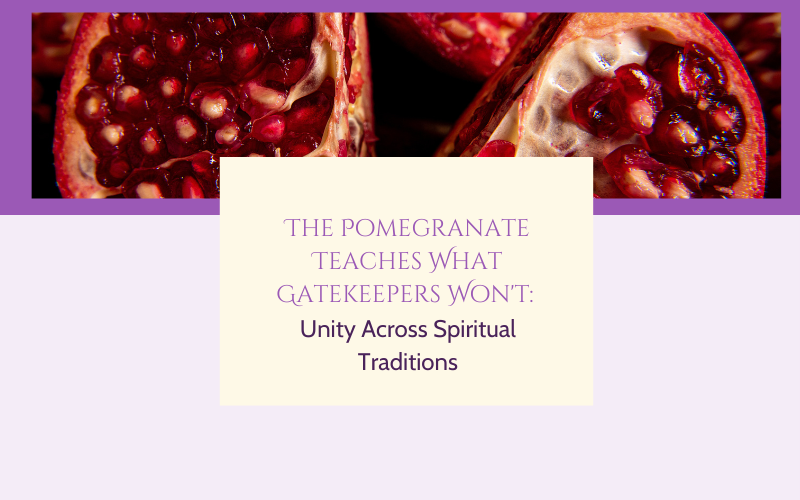
Pomegranate photo by Chris Savaiano
I'm taking a still life photography class, and one of my planned shots includes a pomegranate. Not because it's pretty (though it is), and not because it photographs well (though it does). Because when you hold a pomegranate, you hold Unity in your hands.
That single fruit appears in Judaism, Islam, Christianity, Buddhism, ancient Greece, Persia, Egypt, Assyria, Armenia, and China. Different traditions, different languages, different frameworks - all teaching through the same symbol.
This is what I mean when I say the Tree of Life reveals Unity across spiritual traditions. The pomegranate is a perfect example of how different paths use the same fundamental symbols to navigate the human experience of connecting with the Divine.
What the Pomegranate Teaches
In Judaism, the pomegranate appears during Rosh Hashanah (the new year) with a prayer: "May we be as full of good deeds as the pomegranate is full of seeds." Traditional teaching says it contains 613 seeds - matching the 613 mitzvot (commandments) in Torah. In Kabbalah, the pomegranate represents the structure of spiritual practice itself: the outer shell protecting inner wisdom, each seed a commandment or principle that builds toward wholeness.
The pomegranate also carries sapphic symbolism in modern Jewish culture - the yonic imagery connecting women-loving-women to timeless wisdom about strength, fertility, and the fierce protection of what we hold sacred inside ourselves.
In Islam, the pomegranate is mentioned three times in the Quran as a fruit of paradise. On Yalda Night (the winter solstice celebration marking the longest night of the year), Persians eat pomegranates to welcome the return of light - each seed representing hope, abundance, and the promise that darkness doesn't last forever.
In Christianity, the pomegranate appears in religious art representing the resurrection (the seeds bursting forth from death), the church itself (many members unified in one body), and the Passion of Christ (the red juice symbolizing sacrifice and redemption).
In Greek mythology, the pomegranate binds Persephone to the underworld. She eats six seeds, sealing her fate to spend half the year below ground and half above - giving us the seasons themselves. The pomegranate becomes the symbol of transformation through darkness, of cycles that can't be rushed, of the necessity of descent before ascent.
In Buddhism, it's one of the "three blessed fruits" (alongside peaches and citrus), representing favorable influences and spiritual awakening.
In ancient Egypt and Assyria, pomegranates appeared in rituals and were honored for medicinal and symbolic value - fertility, eternal life, the continuity of existence beyond individual lifetimes.
In Armenian culture, brides break pomegranates at weddings to ensure fertility, marriage, and abundance. In Chinese tradition, the many seeds represent prosperity and "many virtuous offspring" - beyond biological children - the fruit of right action multiplying outward.
Unity, Not Uniformity
Here's what matters: These traditions aren't copying each other. They're independently recognizing the same patterns in Nature and human experience, then teaching through the pomegranate symbol because it perfectly expresses those patterns.
The pomegranate shows us:
→ Abundance within structure (many seeds, one fruit)
→ Protection of inner wisdom (the tough rind guards the seeds)
→ The necessity of breaking open (you can't access the fruit without cracking the shell)
→ Fertility and continuation (each seed can become a new tree)
→ Cycles and seasons (harvest time, dormancy, renewal)
→ Unity in multiplicity (separate seeds, one whole)
Different traditions emphasize different aspects. Judaism focuses on the commandments (structure and discipline). Islam emphasizes paradise and abundance (hope and Divine provision). Christianity sees resurrection (death and transformation). Greek mythology teaches seasonal cycles (the necessity of descent).
They're all pointing at the same fundamental truths about how growth works, how wisdom protects itself, how abundance emerges from structure, how breaking open is required for nourishment.
This is Unity. Not "we're all the same.” Rather, beneath our different languages and practices, we're teaching the same patterns. The Tree of Life maps those patterns. The pomegranate demonstrates them.
The Tree of Life Connection
On the Kabbalah Tree of Life, the pomegranate connects to multiple sephirot:
Binah (Understanding) - the protective outer shell, the container that holds and structures wisdom until it's ready to be revealed.
Tiferet (Beauty/Balance) - the heart center where all forces integrate. The pomegranate's perfect geometry, the way each seed fits into the whole, the balance of sweet and tart.
Yesod (Foundation) - the seeds themselves, potential waiting to actualize, the foundation of future growth.
Malkhut (Kingdom/Physical Reality) - the physical fruit we hold in our hands, harvest and eat, plant and grow. The actualization of all that came before.
The pomegranate moves through the entire Tree. From the protective structure of Binah, through the integration of Tiferet, grounded in Yesod's foundation, actualizing in Malkhut's physical reality. Every tradition recognizes this movement, even when they don't use Kabbalistic language to describe it.
What This Means for Seekers
If you've left organized religion because it felt constraining, exclusive, or dogmatic - and you're hungry for spiritual connection that honors your intelligence and autonomy - I got you! That’s exactly what I teach.
The pomegranate (and hundreds of symbols like it) appears across traditions because the patterns are real. The Tree of Life maps those patterns. And once you understand the map, you can navigate ANY tradition - or create your own path - with confidence and clarity.
You don't need permission from gatekeepers to connect with the Divine. The symbols are all around you. Nature teaches them. The Tree maps them. Your work is learning to see what's always been there.
I've mapped over 40 spiritual and religious traditions to the Tree of Life framework. The pomegranate is one example among thousands of how Unity reveals itself. Not uniformity - we don't all have to practice the same way or believe the same things. Unity means recognizing the same fundamental patterns showing up everywhere, teaching the same truths through different languages.
This is what seekers like you are looking for: connection to something real and timeless, without the gatekeepers and guilt. The pomegranate offers that. So does the Tree of Life.
Nature as First Teacher
Before any sacred text named the pomegranate sacred, it grew. Before any tradition claimed it, Nature created it. The fruit itself teaches - structure and abundance, protection and generosity, cycles and continuity.
This is why my work centers Nature as first teacher. Not as a metaphor. As a literal teacher. The pomegranate doesn't care what tradition you follow or don't follow. It grows, fruits, seeds, and repeats. The pattern is the pattern. Our job is learning to see it and apply it to our lives.
When I photograph this pomegranate for my still life class, I'll be capturing more than aesthetic beauty. I'll be documenting Unity - the way one fruit holds the wisdom of a dozen traditions, the way Nature teaches what institutions often hide: that we're all working with the same fundamental truths, just using different languages to name them. My vision for this photo also includes elements of Judaism because that’s a big part of my personal spiritual path - at the same time, I intimately understand that those elements are one aspect of the Unity pomegranate shows us.
The Tree of Life gives you the map. The pomegranate (and everything else in Nature) gives you the living lesson. And you - spiritually hungry, religiously burned out seeker- you get to decide how to apply it to YOUR path. No gatekeepers required.
Want to Understand Your Own Symbols?
If you're seeing symbols, patterns, or synchronicities and want to understand what they mean for YOUR spiritual journey - not what some “authority” says they should mean - a Tree of Life card reading can help.
In it, I map where you are on the Tree right now, what's trying to come forward in your path, and the practical next steps for YOUR unique journey. Not a prescribed pathway. YOUR navigation.
Love this wisdom and want to go deeper? Join my mailing list for practical wisdom delivered straight to your inbox. Plus, get exclusive access to parts of my personal journey not shared elsewhere, special deals, and be the first to know what’s coming.